Q&A: KulörGroup reimagines island resort architecture with .Here Maldives
Through the lens of its latest project, .Here Maldives, Christopher Chua, founder and Creative Director of KulörGroup, discusses how context, experience and environmental sensitivity inform the studio’s approach to hospitality architecture.
KulörGroup describes hospitality design as never binary – always a layered interplay of place, people and purpose. How does that philosophy translate into practice, from the first client brief through to completion?
For us, the brief is the beginning of the conversation, not the conclusion. Stakeholders often come with a mix of ambition, constraint and expectation, but hospitality is never solved through a single lens. It has to work spatially, emotionally, operationally and commercially at the same time.
That is where place, people and purpose become practical. Place gives us the logic of the project: how it should sit, open, protect, frame and breathe. People means understanding not only the guest, but also staff, operators, ownership priorities and the rhythms of daily use. Purpose keeps the design honest. It stops a project from becoming either decorative or purely functional.
Our role is to align those layers early, so the project does not fragment later. When the thinking is clear from the outset, the final result tends to feel more assured. The strongest hospitality environments do not need to over-explain themselves. They feel coherent, grounded and inevitable.
Despite being boutique in scale, the studio works across diverse geographies, from the Maldives to urban Asia. How do you ensure each project feels deeply rooted in its local context?
The discipline is in not arriving with a house style. For us, context is not a decorative layer. It is not a material palette, a craft reference or a set of familiar visual cues applied at the end. It has to shape the project much earlier, in the way it is planned, the way it handles climate, the way it opens and closes, and the way people move through it.
That approach allows us to work across very different places without repeating ourselves. In the Maldives, the design response may come from horizon, exposure, water movement and the relationship between shelter and openness. In Vietnam, it may come through a reinterpretation of cultural memory in a more contemporary resort language. In Penang or Bali, it can be about architectural rhythm, tropical breathability, or the care required to reposition an existing asset without losing what gives it resonance.
Projects such as Lux* Phu Quoc, Ascott Penang and Handwritten Nusa Dua Beach Hotel sit in very different contexts, but the principle remains the same. We begin by identifying what is essential to the place, and build from that rather than imposing a pre-formed language. That is what allows the work to remain distinct from one project to the next. If a project is genuinely rooted, you can feel it. It should not need to be over-explained.
When designing island resorts versus urban hotels, how does your approach differ in terms of guest journey and storytelling?
The difference is less about style and more about pace. In an island resort, the project has the chance to shape a guest’s world more completely. Arrival unfolds over time. Movement between land and water matters. Light, weather and distance all become part of the experience. The design can build emotion more gradually.
In an urban hotel, the context is already active. Guests arrive with more momentum, so the architecture has to create clarity, calm and a sense of retreat much faster.
What stays constant is our belief that storytelling should not rely on theatrical gestures. It should come through sequence, atmosphere and what the guest becomes aware of as they move through a space.
At .Here Maldives, that narrative unfolds vertically, from lagoon to sky. In a city, the same principle may play out in a much shorter sequence, but the intent is the same. The most convincing stories in hospitality are lived, not staged.

Environmental sensitivity appears consistently across your portfolio, particularly in the Maldives. How does the studio embed sustainability into the design process, rather than an add-on at the end?
For us, sustainability starts before the language of sustainability usually appears. It begins with how carefully we read the site, how much we choose to build, where intervention should be concentrated, and whether the architecture feels as though it belongs to the landscape rather than being imposed on it. By the time a project is talking only about systems and add-ons, many of the most important decisions have already been made.
Our resort project in the Galápagos makes that especially clear. The scrutiny there begins with the land itself: how the masterplan sits, how buildings engage the terrain, how materiality will weather, and how architecture can feel as though it has grown out of the site rather than been laid over it. That level of resolution has to be embedded from the beginning.
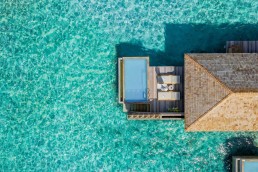
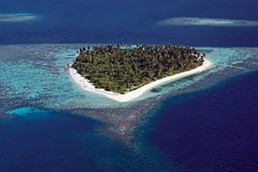
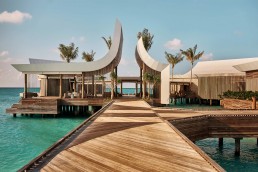
The same thinking applies in very different conditions. At .Here Maldives, we concentrated the resort into seven villas, a sculptural public zone and a private island. Organising the experience vertically reduced the need to spread intervention across the island. In both cases, environmental response is not a secondary layer. It is part of the project’s core design intelligence. That is where sustainability becomes meaningful to us, not as a checklist, but as a way of making better design decisions earlier.
Your latest project, .Here Maldives, challenges traditional horizontal resorts by embracing a vertical design language. How did this concept come about, and how does this format elevate the guest experience?
It came from questioning the default model of island planning. Many Maldivian resorts are organised through dispersal. Guests move outward across distances to access different experiences, views and programmes. We were interested in whether the same richness could be achieved through concentration instead, by stacking and sequencing experience more vertically and more intentionally.
At .Here Maldives, the architecture is organised as a continuous journey from lagoon to sky. Instead of travelling across a large island to find variation, the variation happens through movement itself. Guests arrive close to the water, move through more intimate and shaded moments, and then rise into broader views and elevated communal spaces. The resort becomes more layered, but also more immediate.
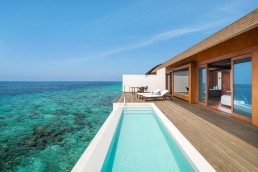
The water strategy is central to that experience. The 45-metre elevated pool is not conceived as a standalone feature, but as a linear spatial device running through the project. It is supported by two distinct pool moments at either end, with a grotto embedded into the sequence, so water is experienced as a series of connected conditions rather than a single amenity. That structure allows the journey to feel more immersive and more varied without relying on scale for effect.
That is where the vertical language becomes meaningful. It is not verticality for novelty’s sake, but a way of bringing intensity, clarity and a different kind of luxury to the guest experience.
The project is also described as duality-driven, drawing on contrasts, such as sunrise and sunset, overwater and grounded. How did KulörGroup implement this across the whole resort masterplan?
For us, duality was never intended as a slogan. It had to be spatial. At masterplan level, the project is organised to keep contrasting conditions in dialogue with one another rather than separating them too neatly. Water and land, shelter and exposure, sunrise and sunset, groundedness and elevation. The guest is constantly moving between these states rather than being presented with them as fixed themes.
Within the villas, that becomes more intimate. Arrival begins low and close to the lagoon, in spaces that feel immediate and protected. As guests move upward, the architecture opens toward the horizon and the experience shifts from immersion to outlook.
The elevated pool extends that thinking across the wider resort. Along its length, and through the differentiated water moments at either end, it allows guests to occupy several readings of the island at once: outward to sea, inward to landscape, downward toward the life of the island and upward into open sky. The grotto adds another layer of contrast, introducing compression and concealment within an otherwise elevated and expansive sequence. That is what duality meant in the project. Not contrast for effect, but contrast as a way of deepening awareness.

Luxury hospitality and environmental responsibility can be seen as contradictory. Where do you see opportunities for the two elements to reinforce each other through design?
They become contradictory when luxury is defined by accumulation. For a long time, the industry has tended to measure luxury by how much is added: more built area, more programme, more features, more visual expression. But that model is becoming harder to defend, environmentally and experientially. More does not automatically create depth.
The opportunity lies in defining luxury more precisely. Better resolved spaces. Stronger connection to climate and landscape. More deliberate sequencing. Greater emotional clarity. In that sense, environmental responsibility can sharpen a project rather than limit it.
At .Here Maldives, that is expressed through concentration. The architecture works harder, each move carries more weight, and the guest experience becomes richer through adjacency rather than repetition.
Aura Maldives, opening in Q3 this year, reflects another side of that thinking. There, luxury comes through calm, protection, tactility and restraint. The experience is more cocooning, more atmospheric and less dependent on visual excess. That kind of quiet confidence can be just as powerful, and often more enduring, than spectacle.
So we do not see sustainability as something that makes luxury less ambitious. We see it as something that asks luxury to become more intelligent.
How do you see sustainability and regenerative design reshaping luxury hospitality over the next decade?
I think the next phase of luxury hospitality will be defined less by separation from place and more by connection to it. For a long time, many projects were conceived as destinations apart, places defined by separation and control. The next decade will demand something more connected. Projects will be judged not only by how little harm they do, but by how meaningfully they engage their ecological, cultural and social context.
That is where regenerative thinking becomes important. It asks whether a project can strengthen its site over time, work with local knowledge and material intelligence, and contribute something back to the place it occupies.
For luxury hospitality, that is a necessary evolution. The most enduring assets will not be the ones chasing novelty. They will be the ones that deepen their relationship with place and remain relevant because of it.