Fenabel offers Autumn field guide for hospitality interiors
Chair manufacturer Fenabel has offered a glimpse at how interiors are evolving in Autumn 2026.
Having acknowledged the expectation that interiors should become warmer in the later months of the year, Fenabel highlights that in 2026, designers are leaning towards a different approach.
Not darker for the sake of drama and not another exercise in seasonal browns, but a more subtle approach centred around slowing the room down.
Fenabel highlights how recent hotel and restaurant projects are moving toward warmer woods, tactile upholstery, low-slung seating, layered lighting and spaces broken into smaller, more intimate zones.
As such, the brand’s Autumn 2026 edit sits naturally within this approach. The collection does not prescribe an autumn palette, and instead asks: what makes a hospitality space feel good to occupy now? “The answer begins with comfort, but not comfort as decoration,” says Fenabel. “It is increasingly visible in the architecture of the room itself.”
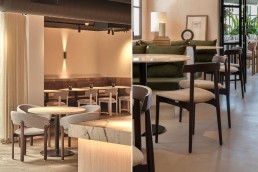
In the restaurant environments, for example, seating does much of the spatial work. Generously upholstered chairs soften the geometry of tables. High-backed lounge chairs create small pockets of privacy without enclosing them. Banquettes run through the space like architectural lines. Darker timber frames prevent otherwise neutral upholstery from becoming visually flat. That balance between softness and structure is one of the clearest directions in current hospitality design.
At the newly opened Andaz Lisbon, Patricia Urquiola layered velvet seating, curved banquettes, rattan, stone and warm wood to create public areas that feel intimate and domestic rather than conventionally hotel-like.
More recently, The Monarch in San Antonio has used warm wood, dimensional stone, tactile textiles and sculptural forms to create a sequence of energetic communal spaces and quieter nooks.
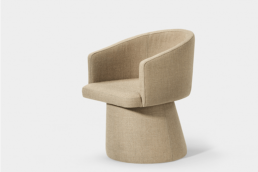
Fenabel’s Holly and Sophie lounge chairs belong to that same shift in scale, with the brand highlighting how neither needs to dominate a room to change it. Their role is more architectural than decorative: positioned in pairs or small groups, they create a pause within a larger floor plan. Around a Jarvis centre table, that pause becomes a destination – somewhere for coffee after lunch, a quieter conversation or the point at which a restaurant subtly turns into an evening lounge.
“That ability to create different speeds within one interior matters increasingly in hospitality,” the brand adds. “A restaurant is rarely only a restaurant now. The same floor may move through breakfast, meetings, lunch, drinks and dinner. Lobbies behave like lounges; bars operate throughout the day; restaurants contain both quick-turn tables and places deliberately designed for longer stays.
“architecture and interior design studio Yodezeen described the Middle Eastern hospitality market in similar terms, pointing to layered environments that can change throughout the day without losing a strong identity. Furniture therefore has to do more than fill a plan. It has to tell people how to use it.”
Fenabel highlights its Chelsea benches as particularly relevant here. Banquette-style seating was once primarily discussed as a way of increasing covers or making efficient use of a wall. In current projects, it has become far more architectural. A long, upholstered bench can establish rhythm, define the perimeter of a dining area, create visual privacy between tables and introduce a large field of texture into an otherwise hard interior.
The vertical channels of the Chelsea upholstery repeat softly across a room, giving the seating almost the same visual weight as timber panelling or wall detailing. Paired with individual chairs and small tables, the bench allows the restaurant to feel layered rather than uniform.
Fenabel also notes how today’s most compelling hospitality interiors rarely depend on a perfectly matched furniture suite, and instead are composed through variation: a more upright dining chair beside an upholstered bench; a sculptural lounge chair around a low table; a distinctive stool at the bar. The furniture belongs together because of proportion, material and atmosphere, not because every piece shares the same silhouette.
Fenabel’s Axis chair works particularly well within that kind of scheme. In a dining room where upholstery is abundant, the clearer structure of a wooden chair introduces definition. Repeated around the Polo table, it can establish a sharper rhythm against softer lounge and banquette areas.
“That contrast is increasingly important. When everything is curved, nothing feels sculptural. When everything is upholstered, softness loses its impact. Good hospitality design depends on tension. Warm timber beside cooler stone. A substantial table paired with a lighter frame.”
The autumn palette emerging around these interiors is therefore less about specific seasonal colours and more about material relationships. The brand asserts that brown remains important, but it has become more nuanced. Deep walnut and espresso tones are being offset by chalky neutrals, grey-blue upholstery, mushroom, oat and cream rather than simply paired with rust or orange. The result feels more contemporary and, crucially, more useful beyond one season.
Recent hospitality projects support that move away from literal seasonal colour. The renovated Breakers Beach Club in Palm Beach, for example, combines warm wood, natural stone, soft azure, terracotta and richly textured finishes, while Dahla in New York uses dark oak, olive velvet, deep emerald upholstery and bronzed surfaces to create atmosphere through layering rather than a single dominant colour.
At the bar, that same thinking becomes more graphic. A row of Tagada or Audrey bar stools can act almost like a repeated architectural detail. Their silhouettes matter because repetition magnifies design. One stool may be an object; eight aligned along a counter become part of the room.
For Fenabel, this is why bar seating deserves more attention than it often receives in specifications. The bar is frequently one of the most photographed and socially active areas in a restaurant or hotel. It also needs to work across different moments of the day.
A stool therefore has to be comfortable enough for someone to stay, compact enough to preserve circulation and distinctive enough to hold its own against stone, timber, lighting and back-bar architecture.
Ultimately, Fenabel highlights how design is moving away from rooms in which atmosphere comes primarily from decoration, and toward rooms where atmosphere is built into the furniture itself, pointing out that while a guest may photograph the ceiling once, they experience the chair for two hours.
Fenabel’s Autumn edit — Holly, Sophie, Chelsea, Polo, Jarvis, Axis, Tagada and Audrey — is therefore less a collection of seasonal objects than a study in how hospitality is becoming more comfortable without becoming casual, warmer without becoming nostalgic, and quieter without losing character.
“The most relevant interiors this autumn will not necessarily look autumnal,” the brand concludes. “They will simply feel harder to leave.”