Roar has unveiled the design concept for Story Le Carrousel Rabat, a hotel that reimagines Amazigh cultural identity through a contemporary architectural language rooted in narrative, materiality, and movement.
Located along the Atlantic coastline, the project sits between heritage and modernity, drawing from Rabat’s evolving cultural landscape. The design moves beyond conventional hospitality planning, positioning the hotel as an experiential journey shaped by craft, atmosphere, and spatial storytelling.
The concept is based on an Amazigh approach, translating traditional codes and craftsmanship into a refined and minimal spatial language.

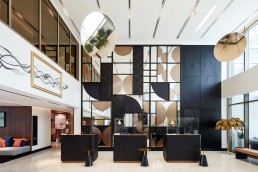
The arrival experience is defined by a sculptural ramp that moves through the lobby, guiding circulation and framing views. Inspired by historic caravan routes, it introduces a sense of procession and gradual discovery.
Surfaces act as narrative elements throughout the space. Wall treatments reinterpret traditional weaving techniques as large-scale reliefs, embedding craft into the architecture rather than applying it as decoration.
“We wanted to distill Amazigh heritage into something more abstract and architectural, where culture is felt through space rather than explicitly shown,” says Pallavi Dean.
At its core, the project draws from the legacy of the Amazigh people, descendants of the pre-Arab inhabitants of North Africa, whose lives were shaped by movement, craft, and a deep connection to the land.
Historically, Amazigh communities lived nomadically across Morocco. Their daily rhythms were defined by a division of craft and care, with women gathering plants to create natural dyes and men tending to livestock that provided wool for weaving. These materials formed the foundation of kilims and tapestries, objects that carried both function and identity.
This relationship between material, process, and storytelling informs the design language of the hotel. Elements of Amazigh life are translated into contemporary architectural gestures, where joinery, pattern, and materiality act as a continuation of these traditions rather than a replication.
Textiles become spatial. The geometric logic of traditional Berber rugs informs the composition of flooring, wall patterns, and custom elements throughout the hotel. These motifs are abstracted and scaled, creating a contemporary interpretation of heritage that feels both familiar and new.
Symbolism plays a subtle but intentional role. The forms of Tuareg jewelry and protective amulets are reinterpreted as wayfinding elements and signage across the space, translating personal objects into a collective spatial language.
Embroidery traditions further influence the material palette and detailing. Rabat embroidery inspires a restrained and tonal approach, while Fez embroidery introduces layered geometries and mirrored compositions that inform more intricate surfaces within the design.
Rather than acting as decoration, these references are treated as a system of knowledge, where craft becomes structure, symbolism becomes navigation, and heritage becomes spatial experience.

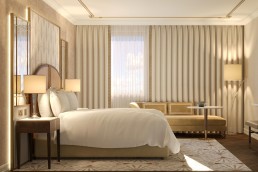
Guestrooms and suites balance calmness with fluidity, using natural materials and a muted palette inspired by Morocco’s landscapes.
Soft lighting and layered textures create interiors that feel both grounded and open. The spaces reference the rhythm of nomadic life while maintaining a sense of permanence, offering a quiet contrast to the more expressive public areas.
The hotel is conceived as a sequence of evolving environments rather than fixed destinations. Rooms are oriented towards uninterrupted ocean views, reinforcing the connection to the Atlantic. At rooftop level, the experience shifts into a more social setting, with lighting, live cooking, and music shaping an atmosphere that evolves from day to night.
A specialty restaurant draws from Spanish culinary traditions, reinterpreted through Moroccan flavours, while the ballroom overlooking the ocean is designed as a flexible setting for events and gatherings.