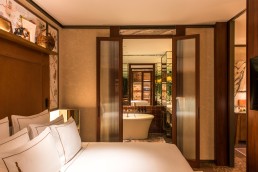
Philippe Starck has unveiled his vision for Nhà Estate, a beachfront residential project in Ho Tram.
Located on a peninsula between the Ray River and the sea, Nhà Estate comprises 38 private villas in Ho Tram, each individually designed to achieve a seamless integration with the outdoors, honouring the site’s original beauty as if the architecture had emerged naturally from the terrain. The estate is conceived as a village with a highly organic masterplan, shaped by the harmony of sea and river and complemented by a beach club, restaurants and generous communal spaces. The villas mark the first phase of the community, which will be followed by a hotel at a later date.
At the invitation of Vietnam-based international investors and developers Larfa Properties and AppleTree Group, the project represents the first time Starck has lent his creative vision to a residential concept in Vietnam, a place that Starck imagined as if “it has always existed, timeless in its elegance and poetry. An elsewhere in Vietnam.”

With a career spanning over four decades, Philippe Starck has conceived a vast portfolio of global icons, from everyday objects to architectural landmarks, always with the human experience at the core. To him, a space truly succeeds when it stirs the emotions and fosters a deep harmony between people, their community and the environment.
It was therefore only natural that it all started with a human encounter between the Merlin family and Philippe Starck – a meeting that was meant to be, between partners sharing the same values, philosophy and ethics. When they discovered the unique landscape of Ho Tram, together they recognised the rare opportunity to create a place rooted in truth, honest in its design and intelligent in its purpose: a preserved place built to endure, where architecture becomes a natural extension of the landscape.
“Nhà Estate is a home of life and humanity, honesty and harmony,” explains Starck. “Here, everything is imagined to awaken intelligence, inspire creativity. It is a place to be more in love, more alive and more human.”
Starck fully embraced the local landscape, ensuring that Nhà Estate reflects a global spirit rooted in a profound respect for Vietnamese culture. The project serves as a bridge between Starck’s humanistic creative vision and an Eastern sensibility — one that prioritises a kinship with nature, a spirit of community and a graceful balance between heritage and progress.
Here, architecture is shaped through subtle dialogues between land and water, warmth and luminosity, openness and privacy, lightness and durability. The foundation of each home is formed from solid stone masses, evoking ancient constructions. From this grounded base, the upper levels open up through expansive glass frames and refined structures, each Nhà Estate villa is conceived to allow natural light, sea breezes, and the surrounding landscape to flow into every living space, always with views of the water. Nhà Estate, the first project imagined by Philippe Starck in Vietnam
For many years, Vietnam’s high-end resort real estate market has been defined by scale and investment volume. Nhà Estate, however, takes a different path by placing emphasis on the quality of experience and the relationship between people and their living environment. The emergence of Nhà Estate is closely tied to the transformation of Ho Tram, one of the few coastal stretches in southern Vietnam that has preserved much of its pristine character.
“We believe that the true value of a project does not lie in short-term profit, but in its ability to endure and be appreciated over time,” says Eric Merlin, CEO of AppleTree Group. “Nhà Estate was conceived as an unconventional development. It is a philosophy of living, where architecture, nature, and people rediscover their balance. Our aspiration is to create a place that holds meaning today and continues to matter for generations to come.”