Waldorf Astoria New York has kicked off its opening season with a first look at the world-famous property’s restoration and redesign led by Skidmore, Owings & Merrill (SOM), Pierre-Yves Rochon (PYR) and Jean-Louis Deniot.
The reimagined property recaptures the grandeur of the hotel’s original Art Deco architecture and rich history, while integrating contemporary furnishings, cutting-edge technology and high-end finishes.
SOM’s work is a blend of preservation, restoration and adaptive reuse, preserving the integrity of the original 1931 design of Waldorf Astoria New York while positioning the building for its future.
The interiors meanwhile, entrusted to PYR, establishes a deliberate spatial sequence, from enclosed, intimate thresholds to expansive, light-filled volumes, articulated through material and tonal consistency.
PYR’s signature ‘cinematic luxury’ approach is exemplified throughout Waldorf Astoria New York, treating the hotel as a permanent movie set. As such, the experience of walking through the Waldorf Astoria is conceived as a succession of acts – from threshold to vestibule, from gallery to lounge, with each space introducing a shift in mood, tempo and intensity.
The project merges 1930s American Art Deco with contemporary French refinement, approaching the building as an archive of design intelligence, where volumes, materials, decorative motifs and structural rhythms were already encoded within the architecture.
Rather than overwriting this legacy, the design sought to preserve and reveal it. “You don’t reinvent a place like the Waldorf Astoria,” Rochon explains. “You listen to it. The architecture speaks. My role was to interpret that voice with sensitivity.”
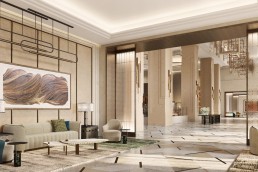
In the entirely restructured lobby, the check-in area has been relocated outside of Peacock Alley, allowing the central space to function as an enfilade linking the Park Avenue and Lexington entrances. The room’s original maple burl veneer was restored; a 1950s frieze was removed, revealing a taller, more proportioned space. The new layout reclaims clarity, flow and spatial rhythm.
Furthermore, in a change that restored the full height of the original lobby and reintroduced natural light into the space, SOM and PYR removed the mezzanine level above the Park Avenue entrance, reconnecting the monumental facade to the interior sequence, eliminating a visual barrier and reinforcing axial symmetry between Park and Lexington Avenues.
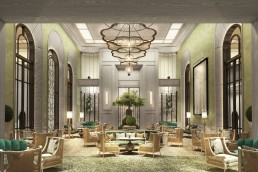
The historic Peacock Alley was redesigned as a central gathering space, organised around the restored 11ft clock originally crafted for the 1893 Chicago World’s Fair. The area now features restored maple burl veneer, black marble columns and a custom fish motif carpet that subtly references the Sert Room.

The space also integrates handcrafted plasterwork, a meticulous polychromatic ceiling restoration, and furniture with studied proportions, while the finishes emphasise authenticity and tactility through natural materials, bronze accents and bespoke furnishings that bridge historical integrity with restrained contemporary elegance.
The design integrates the refined tones of celadon, taupe and white with authentic materials and layered lighting strategies. Natural daylight, ambient lighting and custom crystal chandeliers work together to establish visual clarity, softness and depth. Lighting sequences follow the architectural composition, supporting the spatial rhythm and enhancing focal points.
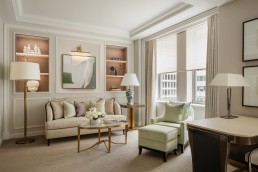
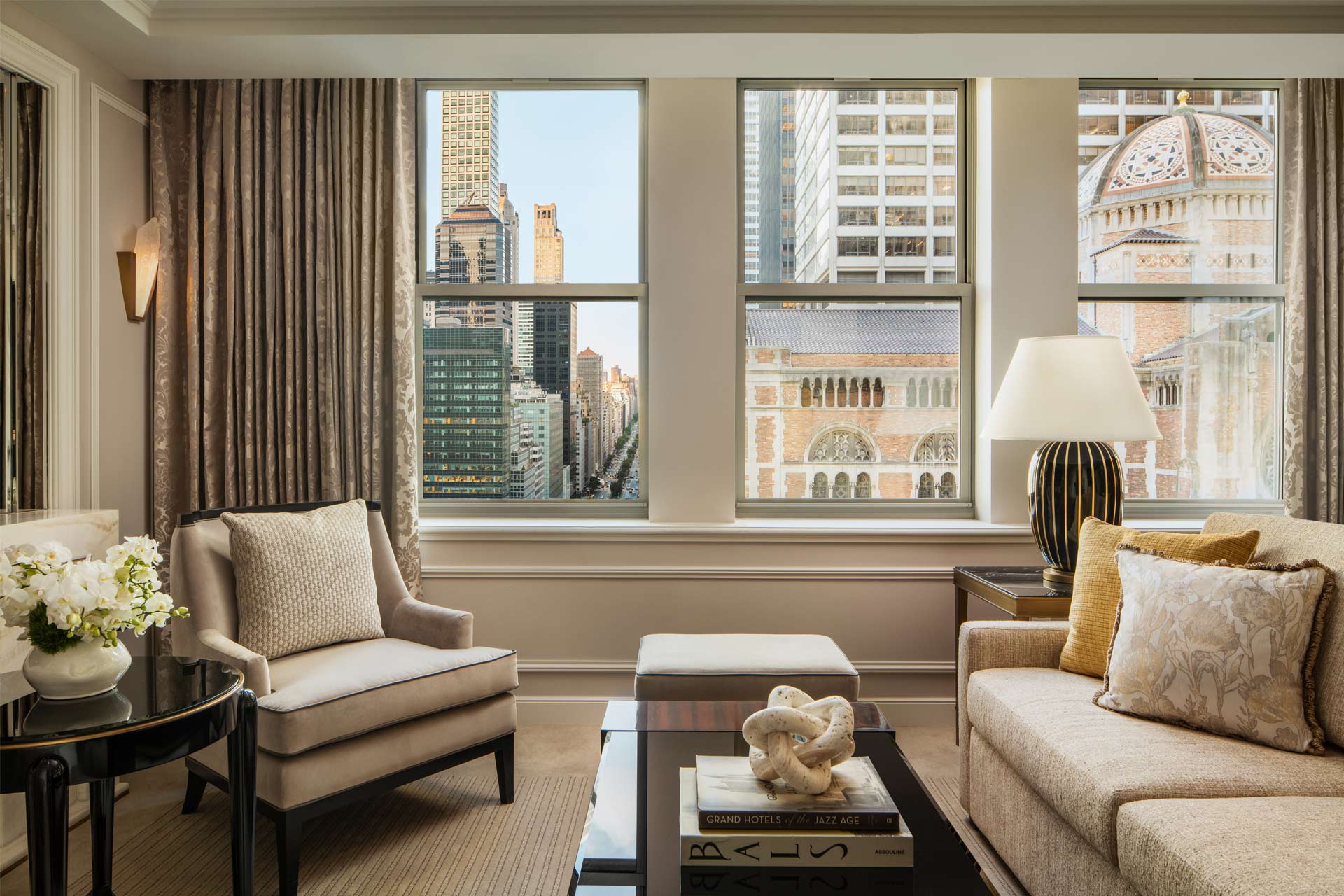
Meanwhile, following the hotel’s transformation from a 1,400-room hotel to 375 hotel guest rooms and 372 residences, Waldorf Astoria New York will offer some of the largest guest rooms and suites in Manhattan, with most the hotel’s guest rooms exceeding 570ft2. Guests will experience modern design with a residential feel, with expanded layouts and spacious bathrooms.
With more than 11 different guest room categories, rooms are designed to feel like private apartments, featuring distinct yet connected zones for living, working and sleeping. Featuring soft leathers, polished woods and tailored upholstery in a palette of light neutral tones, guest rooms will provide a respite from the bustle of Manhattan. Custom furniture and artisanal hardware elevate the hotel’s sense of luxury and exclusivity, with a bespoke bar in each room.
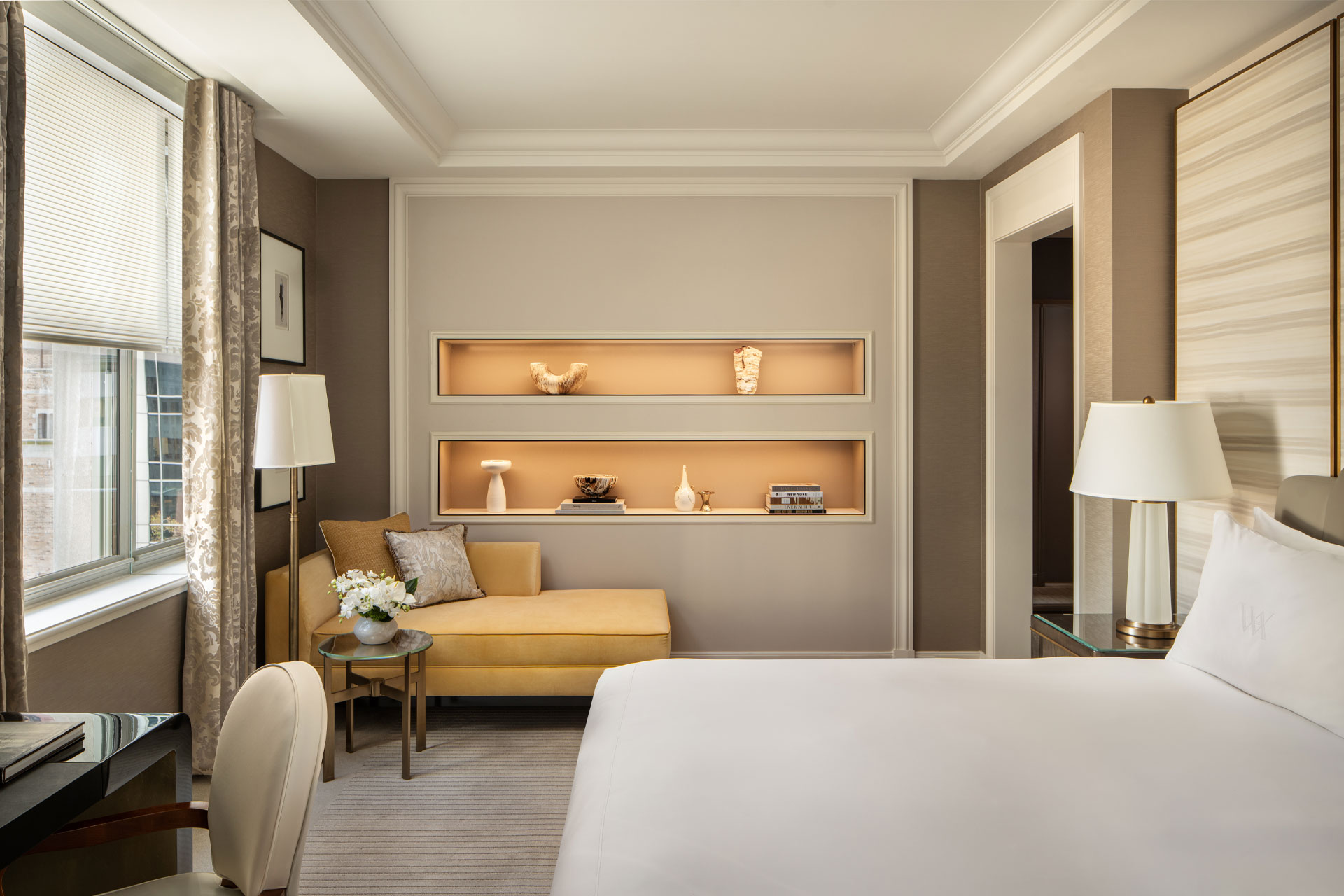
The hotel’s residences, with interiors and amenities by internationally acclaimed interior designer Jean-Louis Deniot, range from gracious studios to opulent four bedrooms and penthouses, including several marquee residences with expansive private terraces.
In addition to its reimagined guestrooms and suites, the hotel will feature the Guerlain Wellness Spa and three distinctive food and beverage experiences – Chef Michael Anthony’s signature brasserie Lex Yard, Peacock Alley and the Japanese dining concept Yoshoku. The hotel’s 43,000ft2 of meetings and events spaces will also make their grand return, including the Grand Ballroom and Basildon, Jade and Astor Rooms.
“In many ways, Waldorf Astoria New York is the most important hotel in the world. It is the original luxury property and the place where luxury service was perfected. It not only holds a special place in Hilton’s history, but also in modern history,” said Chris Nassetta, president and CEO, Hilton.
“Today, we build on this legacy as we mark the start of a new chapter for this iconic property. We look forward to once again welcoming guests to experience its timeless charm and modern enhancements, as this hotel and Waldorf Astoria properties around the world set the standard for luxury stays.”